[wrong & bad] everything i know about nutrition in one document
EDIT 2025-01-15 :
I now think that substantial portions of this are poorly framed/unhelpful or oversimplified to the point of being seriously, meaningfully wrong. You should view the below as being a historical artifact of Saul’s understanding of nutrition, including all the ways in which that map doesn’t track reality, and ~nothing else. My guess is that this post is a better overall “guide to nutrition,” though similar caveats as below apply.
In particular, I think I’m grossly wrong about carbs, fairly wrong about proteins & fats, framed misleadingly to overemphasize CICO (calories-in-calories-out) and underemphasize non-caloric nutrition, and probably a few other things.
not done. last significant update on roughly 2024-11-13.
Epistemic status: written quickly, based on a rough understanding of mediocre literature. Take my words with lots of salt. I don’t cite any sources; the numbers I use are ballpark estimates from quick googles (though I’m quite confident that they’re all within the right ballpark). Much of the knowledge in here comes from conversations with people who know far more than I; thanks in particular to David Rapperport, Shri Samson, and Chris Sims.
I expect this doc to be most useful to people who feel constantly overwhelmed at all the big words in diet science; people who don’t really know what those words cache out to, but who also find themselves annoyed at pop infoscience for being wrong and clickbaity and untrustworthy. You can skim by reading the bold parts; each underlined term is where that term was first introduced/explained/defined.
Most of this doc applies to everyone who’s a human, but I’ve noted the parts that only apply to specific subsets of people (e.g. if you’re trying to gain muscle/lose fat/other goals).
I’m not a doctor. Your mileage may vary. Much advice in here doesn’t apply to many people. Talk to your doctor before you do anything stupid. All of these other caveats apply.
-
Your body gets energy (from food) and uses energy (by exercising, and some other stuff)
-
That energy in your body is measured in calories. A “calorie” is simply a unit of energy.
-
When you eat something, it gives you a certain amount of energy — a certain number of calories “in.” We call this caloric intake****. Some numbers to give you bearings:
- McDonald’s cheeseburger ≈ +300 calories
- Medium sized carrot ≈ +25 calories
- 1 cup of milk ≈ +100 calories
- 1 pound of steak ≈ +1200 calories
-
When you do some exercise (and some other stuff), it costs some amount of energy — a certain number of calories “out.” We call this caloric expenditure****. Some numbers to give you bearings:
- 1 mile run ≈ -100 calories
- Marathon ≈ -2600 calories
- Bodyweight squats for a minute ≈ -6 to -8 calories
- Automatic brain processes in a day ≈ -400 to -600 calories
- (note that you are constantly doing stuff that burns calories, so long as you’re alive)
-
Caloric intake comes in three varieties
-
People call the set of these three varieties “macronutrients,” just to be a little extra confusing. Each one of them is called a macronutrient.
-
Let’s say you kept caloric budget constant===FINISH
-
Proteins
- TLDR: good. Eat more of ‘em.
- Proteins are basically always good
- The general advice is “eat more protein” (especially for folks who’re trying to gain muscle), but when I heard that the first gazillion times, it mostly bounced off — I didn’t have a good intuition for “...but how much protein should I actually eat?”
- specifically for weightlifting/folks aiming to gain muscle, you should shoot for ~0.8 grams of protein per pound you weigh. as of my writing this, i weigh ~140, and i shoot for ~112 grams of protein per day.
- 1 gram of protein ≈ 4 calories (remember — proteins are one variety of calorie!)
- some foods that have a lot of proteins:
- meat
- tofu
- dairy (milk, chees, butter)
- some beans, some nuts
-
Carbohydrates
- TLDR: mostly bad. Reduce where possible.
- my impression is that carbs are themselves nutritionally useless, but sometimes still practically useful. more specifically, although you could technically completely cut carbs from your diet:
- some foods are basically carbs + vitamins/minerals which are really good for you (e.g. some vegetables)
- carbs give you a lot of energy (calories) fast. if you need energy to e.g. exercise, it might be useful to carb load a few hours beforehand.
- …but you really can completely cut carbs out of your diet! doing this is called a “keto diet”
- when you haven’t had carbs in a while, your body flips into a mode where it starts burning your stored, spare fat for extra energy like crazy. this mode is called “ketosis”
- read more about ketosis here
- not all carbs are the same
- IMPORTANT: some items of nutrition — unrelated to caloric intake — are extremely important, and difficult to get in ways that don’t also include some intake of carbs, or even are themselves carbs. ex: bananas are ~entirely carbs (which is bad), but also have a lot of potassium (which is good, and hard to otherwise get). ex: fiber is essential for digestion, but also fiber is literally a type of carb.
- so the maxim “delete all carbs” is probably overkill, but “delete most carbs” is probably right, and “be very careful that when you do eat carbs, it’s to get a particular thing you need” is great
- “carbs” breaks down into a whole lot of things, primarily including:
- starches (e.g. potatos, wheat)
- fiber (which is necessary for digestion)
- sugar (which is generally bad)
- some other stuff
- starches are completely bad/unecessary; fiber is good, unless you intake an insanely high amount of it; sugars are (generally) bad, though very natural sugars (e.g. fruit) in very low doses (e.g. a couple fruits a day) can be good; the other stuff you basically don’t have to worry about
- IMPORTANT: some items of nutrition — unrelated to caloric intake — are extremely important, and difficult to get in ways that don’t also include some intake of carbs, or even are themselves carbs. ex: bananas are ~entirely carbs (which is bad), but also have a lot of potassium (which is good, and hard to otherwise get). ex: fiber is essential for digestion, but also fiber is literally a type of carb.
- 1 gram of carbs ≈ 4 calories (remember — carbs are one variety of calorie!)
- some foods that have a lot of carbs:
- noodles, pasta
- white bread
- buns
- most fruit
-
Fats
- TLDR: they get a bad rap, sometimes good, sometimes bad
- eating “fats” sounds bad, but this is wrong. some fats are bad, but some fats are good. more specifically:
- unsaturated fat is good (!!)
- saturated fat is sorta bad
- trans fat is really bad
- 1 gram of fats ≈ 9 calories (remember — fats are one variety of calorie!)
from aaron swartz, describing in more detail why the good fats are good and why the bad ones are bad (expand this bullet to see a longer quote)
Fats have gotten a bad rap, most likely because they share a name with body fat but also, some argue, because they seem lower-class. In truth, however, they’re largely just one way to get calories, and a calorie is a calorie no matter where it comes from.
Fats also have effects on cholesterol, a key building block for your body’s cells. There are two types of cholesterol — known informally as good and bad cholesterol. Good cholesterol consists of tightly-packed proteins of cholesterol in your blood stream, allowing cholesterol to be efficiently transported where it needs to go. Bad cholesterol is less densely packed and its cholesterol ends up sticking in the walls of arteries, clogging them and leading to heart disease. Fats have varying effects on cholesterol. Saturated fats should be avoided: they increase levels of bad cholesterol (although they also increase good cholesterol). Unsaturated fats, however, whether monounsaturated or polyunsaturated, are good: they lower bad cholesterol and raising good cholesterol. Trans fats are just the reverse: they increase bad cholesterol levels and decrease good ones; it’s recommended they be avoided as much as possible.
Often nutrition labels only break out unsaturated fats and trans fats; you have to calculate the amount of saturated fat by subtracting these from the amount of total fat. The goal, remember, is to avoid trans fats whenever possible, avoid saturated fats, and go for unsaturated fats.
Quick practice problems based on the above (expand this bullet to see them)
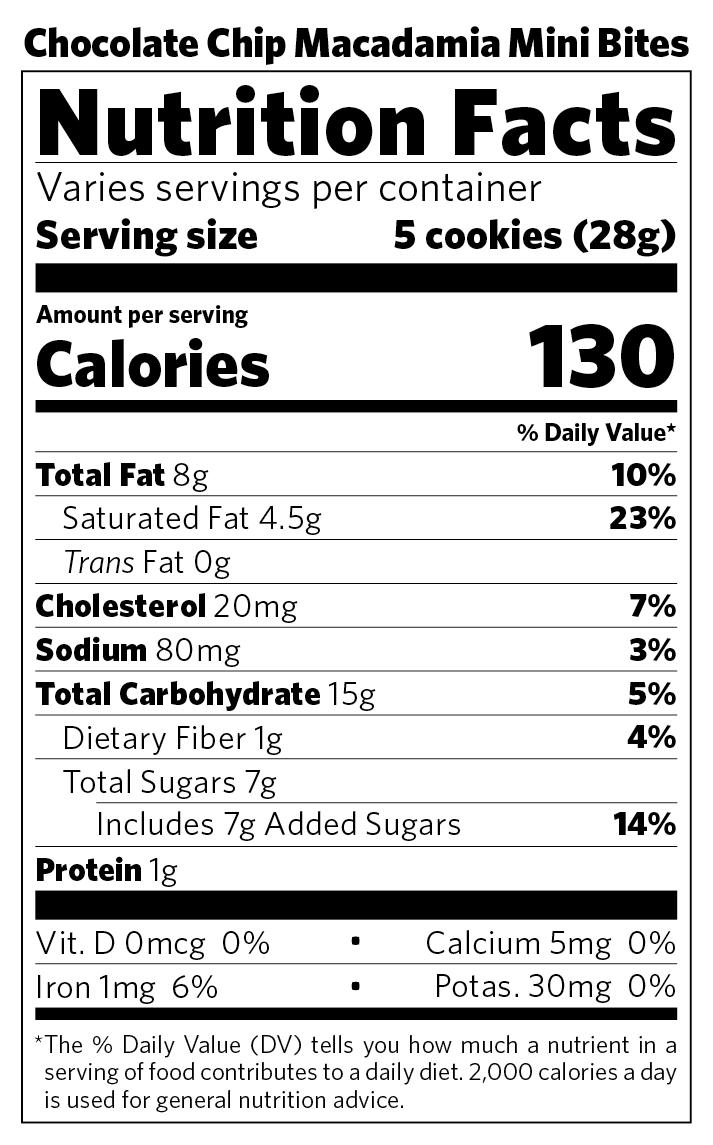
- here are some practice questions based off the below nutrition label. all questions are based on the full container (5 cookies).
-
easier: how many calories in the whole thing? how many grams of protein? how many grams of carbs? how many grams of fats? how many grams of saturated fat? how many grams of trans fat?
-
harder: how many calories come from each of the proteins, carbs, and fats? what proportion of the total caloric intake is from each macronutrient? how many grams of unsaturated fats are there?
-
answers (expand to see the answers)
.
.
. (scroll to see the answers. did you try solving the practice problems first?)
.
.
.
.
.
.
.
.
.
.
easier:
130 calories in the whole thing
1g protein
15g carbs
8g fats
4.5g saturated fat
0g trans fat
harder:
calories
proteins: 4 cals
carbs: 60 cals
fats: 72 cals
caloric intake ratios (the math doesn’t work out perfectly here, if you’re in the right ballpark you’re good)
protein: ~3%
carbs: ~46%
fats: ~55%
3.5g unsaturated fats
-
-
Caloric expenditure comes in four varieties
- The total amount of energy you spend in a day (measured in calories) is called “total daily energy expenditure” (TDEE)
- The set of the varieties of caloric expenditure don’t have a fancy name; people just call them the four components of TDEE.
- Before, I said that caloric expenditure was “exercise and some other stuff.” These are the exercise and other stuffs composing the TDEE.
- Basal metabolic rate (BMR)
- energy (in calories) spent doing the bare minimum to keep you alive — stuff like “breathing” or “heart pumping”
- informally, the number of calories you would expend if you spent 24h sleeping
- this is generally 60-75% of TDEE
- also sometimes called “resting metabolic rate” (RMR)
- Thermic effect of food (TEF)
- energy (in calories) spent digesting food
- usually ~10% of TDEE
- Non-exercise activity thermogenesis (NEAT)
- energy (in calories) spent doing normal daily movements — fidgeting, walking to the front door to pick up a package, picking up something you dropped on the ground, etc
- usually 15-50% of TDEE
- Exercise activity thermogenesis (EAT, funnily enough)
- energy (in calories) spent intentionally exercising — lifting weights, going for a run, etc
- usually 15-50% of TDEE
- this TDEE calculator is pretty great. warning that it tries to sell you some stuff, but the numbers mostly check out (some of the macronutrient recommendations seemed suspicious, everything else checks out).
- Extra notes about caloric intake & caloric expenditure
- you need some number of calories to maintain yourself at your current weight/activity levels/etc (caloric intake = caloric expenditure). we call this “maintenance calories.”
- if you want to gain weight (be it in muscle or fat or whatever), you need to eat more calories than you burn (caloric intake holding > caloric expenditure). we call this “caloric surplus.”
- if you want to lose weight (be it in muscle or fat or whatever), you need to burn more calories than you eat (caloric intake < caloric expenditure). we call this “caloric deficit.”
- you can calculate roughly what level of caloric intake would cause you to be at maintenance, and how many calories will cause you to be in how much of a surplus/deficit, using the TDEE calculator from above. same caveats apply:
- this TDEE calculator is pretty great. warning that it tries to sell you some stuff, but the numbers mostly check out (some of the macronutrient recommendations seemed suspicious, everything else checks out).
- if you hold total caloric intake constant, you can mess around with the ratio of proteins:carbs:fats.
- and in general, and holding total caloric intake constant, reducing carbs is probably a good idea for most people — this means eating more protein and more fat to compensate!
- you’ve probably heard of “bulking” and “cutting.” whats up with that?
- [insert some quotes about bulking and cutting]
- read this for a more in-depth look. pretty great write-up! [LINK JP’S WRITUEP]
- behavioral stuff
- eating disorders are Bad. consider taking steps to avoid them, to mitigate the impact that they might have them, etc. you just read a huge amount of nutritional information, which great, but it’s also a bit of evidence that you might have (or develop) an unhealthy relationship to eating.
- if you think you might be developing one, seek the advice of a licensed therapist, or even just someone who knows what they’re talking about. i’m neither.
- backed by a mild amount of personal anecdotal evidence & claude:
- eat upon feeling hungry. else, don’t eat.
- upon feeling the urge to eat, ask: am I hungry?
- change your diet fairly slowly. spend at least a few weeks — and sometimes longer! — slowly easing into any major diet change
- if you notice yourself eating when you aren’t hungry, peer inward: what’s actually causing you to reach for the food? are you {stressed, anxious, fearful, angry, sad, etc}? how can you work through those emotions more healthily?
- if you notice yourself shying away from food when you’re full, peer inward: what’s actually causing you to reach away from the food? are you {stressed, anxious, fearful, angry, sad, etc}? how can you work through those emotions more healthily?
- make irl friends with well-adjusted, kind folks who are by-default attuned to your eating habits. some obvious examples include parents, siblings, significant others, roommates/flatmates/housemates, gymbros, sports teammates, etc.
- let them know if you think something might be going wrong.
- you want these people to be attuned by-default, and you want to have them well before you need them.
- joel makes the point that diet is endogenous to exercise
- in simple english: the way you relate to your diet often comes from the way you relate to exercising (they’re not necessarily related, but the way you think about exercise affects the way you think about your diet). so, if you want to change your diet, it might be easier to first change your exercise habits, which can put you in a frame of mind more conducive to the sorts of diets you’re interested in.
- i also think this true/good/useful
- your diet affects you, more than you might think. it can make you more:
- tired/energetic
- depressed/manic
- excited/nervous
- relaxed/uptight
- prickly/soft
- etc
- more generally, your diet can affect your outlook on life & the way others see you, quite a bit. be careful here.
- eating disorders are Bad. consider taking steps to avoid them, to mitigate the impact that they might have them, etc. you just read a huge amount of nutritional information, which great, but it’s also a bit of evidence that you might have (or develop) an unhealthy relationship to eating.
- Recap:
- Calories are a measure of energy
- Food causes “calories into the body” — this is called caloric intake
- Exercise (plus some other stuff) causes “calories out of the body” — this is called caloric expenditure
- Bank account analogy
- It’s useful to think of your body’s relationship to energy/calories by analogy to a bank account. The only thing I’ve found that doesn't really hold about this analogy is that you generally want more money in your bank account, but fewer calories in your body, but I’ve still found it useful to guide my thinking with this analogy.
- You have expenses (caloric expenditures) & deposits (caloric intake)
- You can have different types of deposits — income, loans, credit — and different ways of spending — clothes, paying down debt, etc. (These correspond to the macronutrients and the components of TDEE, respectively).
- You have a budget (caloric budget), which can be in a surplus (caloric surplus) or in a deficit (caloric deficit).
Other stuff to include:
- Dieting tips for weightlifting
- bulking
- dirty vs clean bulking
- cutting
- literature on bulking & cutting
- Andrew Rettek’s essay on lifting weights
- bulking
- protein bioavailability (esp for vegetarians)
- see this doc for a summary from gemini advanced research mode
- leucine (amino acid)
- non-caloric nutrition
- vitamins, minerals — what’s actually going on here?
- dietary fiber — what is it good for? how much of it do you need?
- metabolic set points
- ozempic/etc
- intermittent mimicking fast — hyperlink that sarah constantin article
- fast carbs versus slow carbs
- different types of sugar — E.g. fructose, glucose, sucrose, etc.