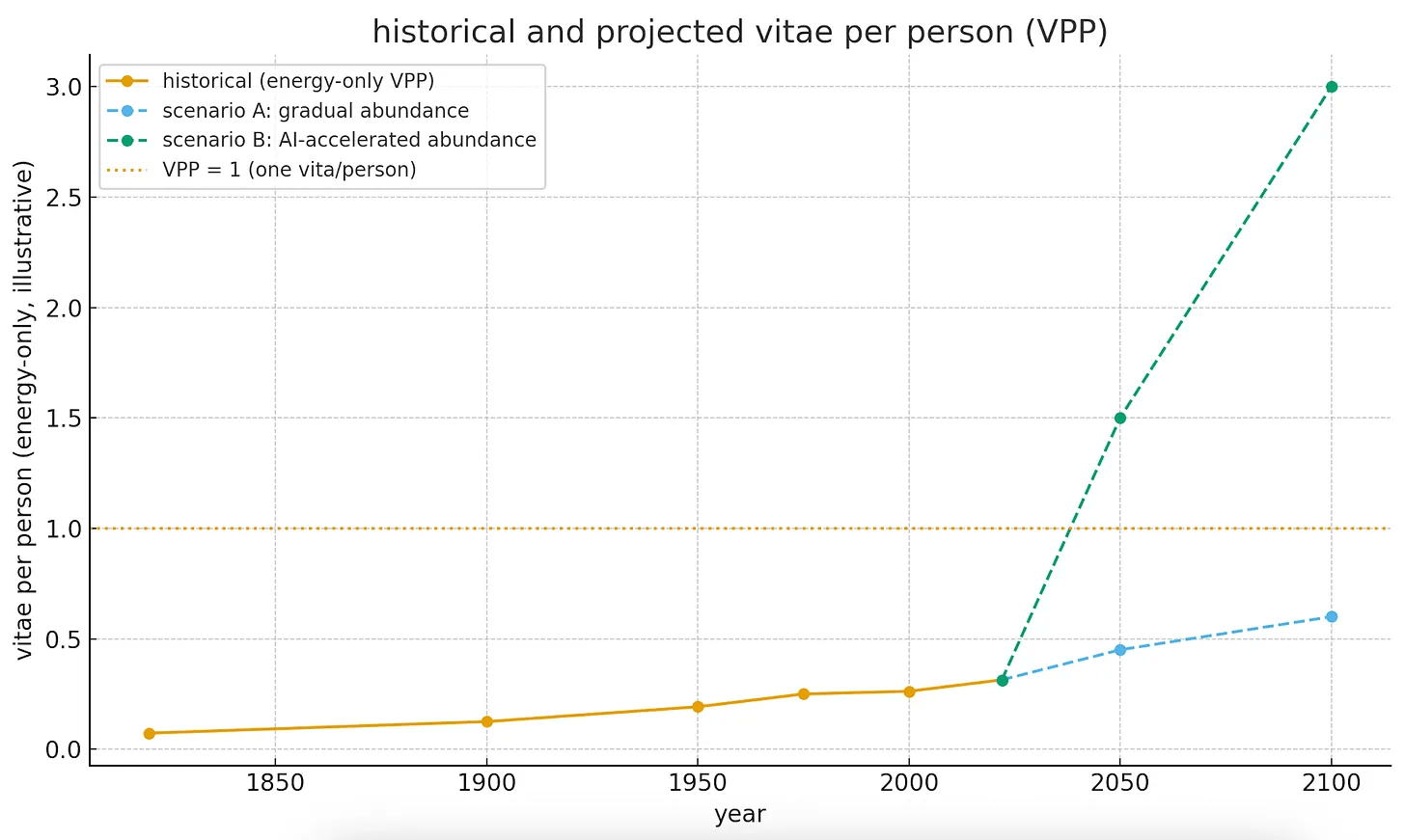
Do we have enough resources for every person on the planet? Each person needs to consume some fixed amount of resources each year — food, energy, water, earth metals, … — to live as well as your average American coastal elite. So I’d like to propose a new unit:
1 vita = {annual energy, clean water, protein, transport, m² climate-controlled indoor space, compute, communications bandwidth, consumer-durables flow}, each specified at 2025 “coastal-elite” service levels.[^1]
…
If we live in a world with 10 VPP, I’m not at all worried about whether I personally am employed or not, because I can rely on benevolence and altruism to spot me a vita and help me out.[^2]
If we live in a world with 1-2 VPP, I’m a bit more concerned. You can probably buy significant marginal utility in the 1-2 vita range; I don’t think redistribution is automatic in this world.
And if we live in a world with <1 VPP — which it’s my impression we currently do — my top priority is moving us towards a world with at least 8 billion vitae (one for each person alive today).
…
I measure my civilization not by its unemployment figures but by VPP. If we have abundant VPP, looking after everyone is just a redistributive question. Since VPP is determined by the scarcest resource, this is one case where you do want to raise the floor![^3]
AI deployment and economic policy should be evaluated on:
“What path do they put us on for VPP by 2050 / 2100?”
A policy that keeps VPP at 0.3 while “preserving jobs” is bad.
A policy that risks existential catastrophe to chase VPP 1,000 is also bad.
We want the Pareto frontier: maximize long-run VPP subject to not dying.
Footnotes
[^1 This is the per-person analog of Kardashev’s civilizational energy parameter. Currently, humanity is measured on the Kardashev scale at K = ~ 0.72: that’s how far we’ve progressed, on a log scale, from a pre-industrial species (K ≈ 0) to a full planetary-energy civilization (K = 1). We’re a factor ~500 too small to be type I.
Today: 0.3 VPP
Type I: 40 VPP]
[^2 I think this stands for as long as humans are similar enough to each other that our elite can’t conscience hoarding vitae when some people have <1.]
[^3 I’d happily see there be an EA / international org that:
Estimates the factors that go into a vita
Identifies / hones in on the lowest
Supports initiatives to raise it
Rinse and repeat]
(small changes — emphasis, footnote formatting, <br>s — made from the original)
I think quantifying vitae is a pretty brilliant move. In particular, I think having a better conceptual & empirical understanding of a quantified vita will give (especially EA) organizations a better sense of how to optimize for it.
As a quick first-pass sketch, Lydia’s definition of a vita seems decent, except:
each specified at 2025 “coastal-elite” service levels.
…why?
2025 coastal-elite seems like (a) a pretty arbitrary point, and (b) a substantially higher point than how I’d style my answer to the question “Do we have enough resources for everyone on the planet.” Like, I realize we’ll probably need to pick some line in the sand, and so whatever line we pick will likely be arbitrary to some degree, but to the extent that Lydia had any sort of reason for picking this one, it’d be cool to know why.
But my biggest point of disagreement is that it seems like Lydia is totally underestimating distributive concerns. This is both a question of operations (”is our civilization capable of distributing vitae to everyone?”) and also a question of incentives (”assuming our civilization is capable of such distribution, will the relevant actors actually do so?”).
Lydia:
If we live in a world with 10 VPP, I’m not at all worried about whether I personally am employed or not, because I can rely on benevolence and altruism to spot me a vita and help me out.
Then, in a footnote:
I think this stands for as long as humans are similar enough to each other that our elite can’t conscience hoarding vitae when some people have <1.
I’m really not sure about that at all? For example, there are subpopulations of humans where there are >10 VPP — e.g. luxury hotels in very poor countries — and where plenty of the humans (e.g. the cleaning staff) living there have <1 vita.
Another way of putting this is that — yes, I agree with her conditional, but I think the bar for “humans are similar enough” is descriptively-and-not-normatively much higher (e.g. speaking the same language, having the same skin color, etc) than she seems to think.
Lydia:
If we have abundant VPP, looking after everyone is just a redistributive question.
“Just” is doing way, way too much work here.
I’m not sure which would be harder: getting to a world with 10 VPP; or, given a world with 10 VPP, distributing it such that ≥90% of people have ≥1 vitae.
Indeed, in some sense we “already” have ≥10 VPP — the energy is just a bit far away (in stars), the clean water is just not quite clean enough (needs desalination from the oceans), etc. I’m not sure there’s a joint to be carved between getting to a world where we “have” ≥10 VPP and distributing the vitae in such a world to get everyone above 1 vitae.