Get started with Anki
What follows are my notes & some retrospective reflections on a workshop I gave in summer 2025 at Manifest to folks who’re interested in starting to use Anki.
Reflections
-
What happened?
- ~8 people showed up
- I started with writing prompts for ~5 minutes as people trickled in
-
Meta processes that would’ve helped a lot:
- Give a practice one, lol; record it
-
Have a fresh Anki that you could demo downloading, opening, and adding cards to
-
Have a few premade card ideas that you could demo adding to the deck
- Maybe go through the process of making a card or two with people
-
Demo studying those cards
-
Have resources to send them prepped out (e.g. Gwern, ALTM, etc)
-
Have more of a structure ahead of time, and signal that structure
-
What particularly good things happened?
- The prompts
- Give more prompts that are more generative
- Make it a little less open-ended
- Add things that are more action-based (e.g. “look through your chatgpt history” was good)
- Add more; like, 2-4x as much
- Write them down in a place that will be durable when you move your computer around (e.g. write them on a notepad)
- Give more prompts that are more generative
- People felt comfortable asking questions — maybe explicitly encourage this in the beginning
- The prompts
-
Particularly bad:
- Have the framings down into much-more-crisp packages. E.g.:
- A card will take 5-15 minutes through the duration of its life. If you just added a deck that contains 50 cards — would you enjoy spending the next 8 hours studying it?
- Right now, your goal should not be “trying to use Anki to its best”; instead, your goal should be “trying to get yourself in a state where, 6 months from now, or a year from now, you’re using Anki effectively — regularly, and getting a lot of value out of it.”
- The answer to “should I learn X feature of Anki?” is typically “not until you’ve used Anki for a few minutes/day for a few months.” There are a lot of really powerful features on Anki. Probably, you basically shouldn’t think about them at all until you’ve built a habit of using Anki for a few months, for 2-5 minutes a day, 95%+ of days.
- Maybe some meta-framing was missing? something like “by default, a lot of your mental models for approaching this will be pretty deeply flawed, in ways that aren’t obvious to you. What it’ll feel like to learn how to use Anki well may be sorta analogous to, if you totally forgot the skill of ‘taking notes’ (e.g. in lectures & meetings, on papers & textbooks), learning how to effectively note-take from scratch. That’s hard!”
- Have the framings down into much-more-crisp packages. E.g.:
Prompts
-
What are you (enjoying) learning about right now?
- Examples from my personal life:
- Poker
- Math
- What are bits of jargon you continually get confused about?
- What are concepts that you notice keep popping up? Have you looked them up? If so, how many times?
- Examples from my personal life:
-
What activities are bottlenecked by the capacity of your working memory?
- Context-switching makes the thing really difficult, you often try to block out a few hours at a time to work on it
- You often feel like you’re holding a number of elements in your head all at once, and sort of weaving them together — if someone interrupts you, you feel like you have to “start over”
- Examples of activities bottlenecked by WM capacity:
- Navigating through a city while doing something else (talking to someone, listening to a podcast)
- Programming
- Making Fermi estimates (about compensation packages, currency conversions, scale of national economies)
-
What do you repeatedly look up, at least a few times a week?
- Look through your search history on your browser, on ChatGPT/Claude, etc
- Download your search histories, throw them at an LLM, ask them to see what you repeatedly look up
Examples:
- When starting to learn a field/subfield/skill, basic terms & concepts that constantly pop up
- Syntax of a bit of a code or math
- Some important number for doing quick estimates in your field (e.g. how much energy a solar panel can generate in an hour, or the number of dollars flowing through big philanthropies)
- Contextualizing quantities to give you a sense of what numbers of varying OOM in your field matter
- The meaning of a piece of jargon in your field
- The meaning of a word that people often use that you, embarrassingly, don’t actually know
- The name of a paper you frequently cite
- Keyboard shortcuts for tasks you commonly do
- A part of a procedure you frequently do
- Streets/neighborhoods, especially if you’re new to an area
- Small reminders/TAPs (e.g. “when you walk in the front door, put your keys on the keyhook”)
- An ID number (student ID, staff ID, whatever)
- Which months are associated with which numbers (May = 5, November = 11)
- Things that typically take you a minute or two to think about, that you’d rather know instantly/in a second or two
- Ex: some basic math stuff (e.g. exponentiation rules, trig identities);
- Unit conversions
- Practical ones, e.g. “how long does it take to walk a mile” or “how long does it take to drive 1000 miles”
- Jokes
- Enjoyable things to think about: gratefulness, adding stuff to a list, etc — andy’s unusual prompts, art
- Look through your search history on your browser, on ChatGPT/Claude, etc
Intro
- Saul
- Using Anki for 2 years
- ~10-30m /day
- This is my first time teaching this to a group! Please give feedback :)
Schedule
- 5-10m: Intro (of me, Anki, motivations, orientation, framing, etc)
- 5-10m: quietly writing in response to prompts
- 10-15m: showing you around the Anki interface
- 10m: your turn! Make some cards, some decks
- Leftover & in-between: Q&A
What is Anki?
- TLDR: flashcard app w/ spaced repetition
- (plus a ton of extra stuff on top)
- You make flashcards; Anki shows them to you based on how likely you are to forget it
- High level intro to the interface
Why use Anki?
- Get better at everything you do!
- Offload some metacognition about getting better at things
- Remember your rabbitholes; extend the duration of time over which you can dive into them
- Dive deeper faster into new areas/fields/skills/etc
- Get a better sense of how your learn stuff
- (There’s a lot more here, but it’s easier to see the benefits yourself)
Pause for questions
Pitfalls
-
LLM metaphor (thx Jacob)
- “Yeah, I just haven’t found much use from LLMs”
- …you’re probably not aiming them at the right problems
- …you’re probably not using them well
- (admittedly, using Anki is hard!)
-
“Ooh, now that I have this awesome tool, let me apply it to a bunch of things I don’t enjoy spending time on, like memorizing state capitals”
- Each card is 5-15 minutes of your life! That’s a lot!
- Helpful frame: Anki efficiently schedules things for you to think about. Do you want to be thinking about this a lot?
- Be kind to your future self!
-
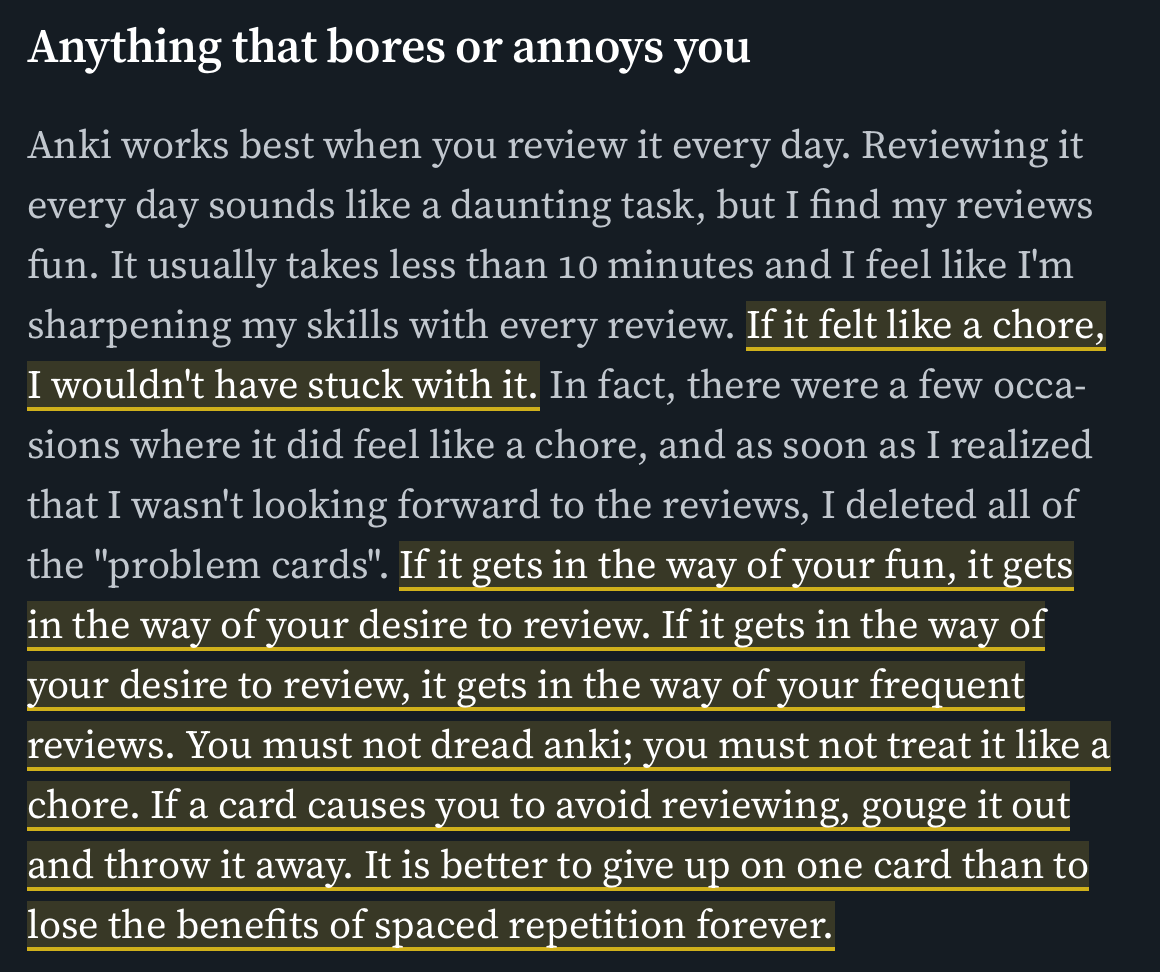
“Anki is boring” // “What I learn on Anki doesn’t transfer to my real life”
- Anki is an app. Your Anki cards might be boring, though!
- Use Anki for stuff you find interesting
- Your cards are going to be the things your spend time on; make sure your cards push you to think about interesting things
-
Breaking streaks
- Download the streaks add-on
- Getting throughAll your cards > 1 card >> 0 cards
- Lots of thoughts on getting back up to speed; can talk more if people want, won’t by default
-
“Gah everything about Anki is so overwhelming”
- You’re building a habit. you’re optimizing for the quality of your anki habit 6 months from now — not the
- Protect the habit, preserve it, make it a pleasurable habit, make it viscerally useful for your life ASAP
Prep
Read:
- [insert readings]
Motivation:
- Turns memory into a choice
- Coathook skill
- Emphasize “anki as a habit” — view it as
-
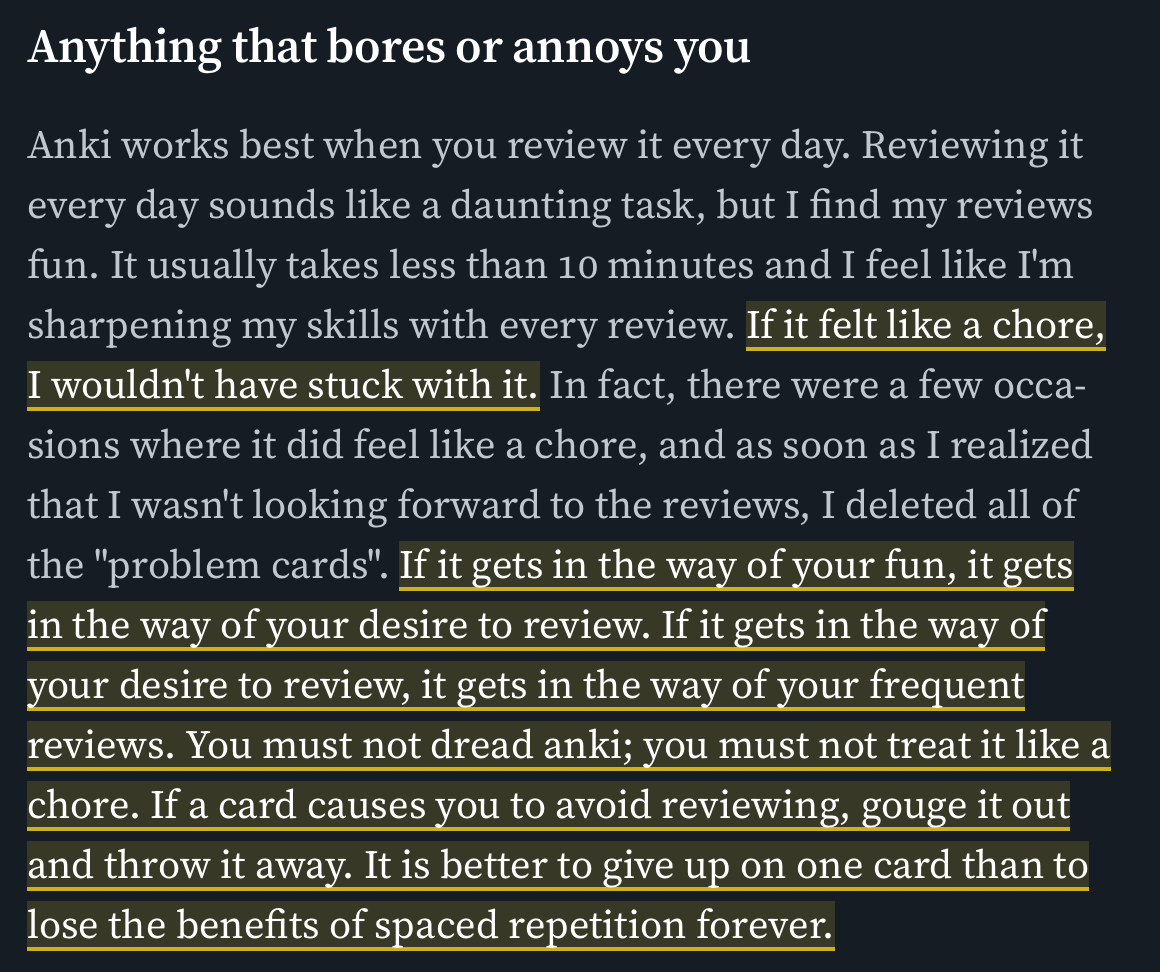
If you find yourself not enjoying doing a particular card, you should suspend/delete it; “it is better to give up on one card than to lose the benefits of spaced repetition forever”
more:
-
[joey said this was the thing he would’ve felt most likely to fuck up had we not talked about it]
-
…this workshop
Target audience:
- “Yeah, I tried Anki once or twice but never really got into it… I probably should, it’s just [insert excuse].”
- “This seemed cool, I wanna join!”
Anti-target audience:
- “I’ve been using Anki for years”
Important:
Violins are an instrument; playing the violin is a skill.
Anki is an app; using Anki effectively is a skill.
Implications:
-
When they start, most Anki users aren’t skillful at using Anki.
-
To improve at the skill of using Anki takes effort — effort that’s independent from just making & reviewing cards.
-
You’re going to run into issues with Anki. “Anki feels boring” or “Anki isn’t useful to me.”
If your violin-playing sounds bad, it’s not because the violin is a bad instrument, it’s because you’re not using it skillfully; analogously, if your Anki-ing is bad, it’s not because Anki is a bad app, it’s because you’re not using it skillfully. Trust me, almost every issue with Anki I’ve heard beginners raise are skill issues, not issues inherent to the app.
-
The marginal benefits from improving at the skill of using Anki relative to the marginal cost of improvement are strongly positive for a long time. After two years of trying to get better at using Anki, if anything, my returns to marginal improvement are increasing.
Other helpful tidbits:
- Over the course of its lifetime, each card will take up 5-15 minutes of time. A useful heuristic is to imagine spending the next 15 minutes just on that one card. Would you enjoy those 15 minutes, or would it be kind of a chore?
(can happen just at the beginning of the session)
Jot some thoughts in response to the following prompts. For each, mentally going through your life — open your calendar and see what sorts of things you typically go to; go through your todo list to jog your memory of what tasks you typically do; review your notes to see what you’ve been learning; etc.
graveyard:
(Not just in terms of navigating the interface, but also e.g. integrating it into their lives, or breaking down their knowledge into effective cards, or keeping their relationship to Anki healthy.)
Anki is an app & a skill that turns memory into a choice.
We'll walk through:
- motivations for using Anki, both good & bad
- default traps/failure modes people make when starting out
- the app's user interface
- building a deck
- q&a, etc
By the end, you'll have:
- a rough sense of the user interface
- a deck you enjoy reviewing & expect to get value from
- a rough sense of how to get good at using Anki
Bring your laptop.
My background with Anki: I'm not an expert (to talk to the experts, Michael Nielsen & Gwern are here!), but I've been using the app for 5-30min/day ~95% of days for the last ~2 years.